Wednesday, 31 October 2012

Top Programmes 31st October

The below grids are based on Sydney activity only and have been coloured according to the following legend:
 
Green: Woolworths had a TV spot appear
Red: Coles had a TV spot appear
Orange: Both Coles and Woolworths had a TV spot appear
 
Grocery  Buyers w/ Children wc 14.10
 
Rank
Program
Channel
Day
Tarps
000's
1
THE X FACTOR RESULTS
7
Tuesday
15.75
296
2
THE X FACTOR PERFORMANCE
7
Monday
13.5
253
3
WINNERS & LOSERS
7
Tuesday
12.63
237
4
60 MINUTES
9
Sunday
12.51
235
5
HOUSE HUSBANDS
9
Sunday
11.79
221
6
BIG BROTHER -TUE
9
Tuesday
10.93
205
7
BIG BROTHER -LITTLE SISTER
9
Wednesday
9.9
186
8
BIG BROTHER -LIVE NOMINATIONS
9
Monday
9.87
185
9
BIG BROTHER -WED
9
Wednesday
9.73
183
10
BEAUTY AND THE GEEK AUSTRALIA
7
Thursday
9.51
178
11
HOME AND AWAY
7
Thursday
9.35
176
12
ANH DOES VIETNAM
7
Sunday
9.19
173
13
CRIMINAL MINDS
7
Wednesday
9.06
170
14
THE BIG BANG THEORY
9
Tuesday
8.96
168
15
SUNDAY NIGHT
7
Sunday
8.87
167
16
BIG BROTHER -MON
9
Monday
8.51
160
17
SEVEN NEWS - SUN
7
Sunday
8.4
158
18
SURVEILLANCE OZ
7
Wednesday
8.39
157
19
MODERN FAMILY
10
Sunday
8.27
155
20
HIGHWAY PATROL-WED
7
Wednesday
8.22
154
 
In this week Woolworths held spots in 70% of the Top 20 programs, as opposed to Coles holding 30%
 
Grocery Buyers w/ Children wc 07.10
 
Rank
Program
Channel
Day
Tarps
000's
1
THE X FACTOR PERFORMANCE
7
Monday
13.88
260
2
UNDERGROUND - THE JULIAN ASSANGE STORY
10
Sunday
13.03
245
3
THE X FACTOR RESULTS
7
Tuesday
12.79
240
4
ANH DOES VIETNAM
7
Sunday
12.04
226
5
WINNERS & LOSERS
7
Tuesday
11.89
223
6
BEAUTY AND THE GEEK AUSTRALIA
7
Thursday
10.41
195
7
BIG BROTHER -LIVE NOMINATIONS
9
Monday
10.25
192
8
60 MINUTES
9
Sunday
10
188
9
HOUSE HUSBANDS
9
Sunday
9.47
178
10
HOME AND AWAY
7
Monday
9.43
177
11
BIG BROTHER -TUE
9
Tuesday
8.99
169
12
V8 SUPERCARS - Podium
7
Sunday
8.87
167
13
BIG BROTHER -THU
9
Thursday
8.87
166
14
HOME AND AWAY
7
Tuesday
8.85
166
15
THE BIG BANG THEORY
9
Tuesday
8.81
165
16
BIG BROTHER -LIVE EVICTION
9
Sunday
8.79
165
17
SUNDAY NIGHT
7
Sunday
8.71
164
18
BIG BROTHER -MON
9
Monday
8.61
162
19
BIG BROTHER -WED
9
Wednesday
8.56
161
20
BIG BROTHER CONFIDENTIAL
9
Thursday
8.52
160
 
In this week, Woolworths held spots in 55% of the Top 20 programs, as opposed to Coles holding 10% 


Monday, 29 October 2012

Tablet Wars

 
By the end of 2012 it’s predicted 4 in 10 Aussie households will have a tablet device*. With those kinds of stats, it’s easy to forget that at the start of 2010 the tablet didn’t even exist. In 2½ short years the tablet continues to rapidly re-define the way we receive and consume media and entertainment – both on the go and in the home.
Last week things got even more interesting in the tablet space with the highly anticipated launch of two new devices – the Windows Surface tablet and Apple’s new Mini iPad. (Cheekily, Apple also launched a new version of the existing iPad, but we’ll save that discussion for another day).
Regardless of the short term impact, most pundits agree that we'll look back on last week as a monumental moment in terms of impact on the digital future. With that in mind, it’s worth spending a bit of time on each.
Windows Surface tablet
 
The launch of this device heralds Microsoft’s first foray into the hardware space. Previously content to deliver software and leave hardware development to others, Microsoft has followed Apple’s lead in an effort to own the end-to-end user experience. On the surface (pardon the pun) it appears to be a worthy competitor to iPad. Similar in dimensions to the iPad, the Surface tablet is slightly wider and thinner, to provide a better movie viewing experience. It comes with a cover on the higher end models, similar to the iPad magnetic cover, that doubles as a keypad, and has a useful stand.
The most noteworthy news however is that it comes with the all-new Windows 8 operating system.
Gone is the familiar ‘Desktop’ environment replaced by a highly intuitive and fluid gesture driven home screen. The screen is populated by dynamic live tiles that bring to life the users’ interests, apps and programs. Similar to content aggregator apps such as Flipboard, the home screen pulls in the users’ social feeds, favourite sites, apps and programs, essentially meaning the social and content world is coming to them.
The layout is highly engaging and easy to use and content appears much visually richer in this new environment. This is the biggest nod to the future and shows that the way we will all be interacting and engaging with our content - whether it be social, news, email, sports, entertainment etc – is reaching a tipping point.
Oh, and of course it’s worth mentioning that unlike the iPad, the Surface comes with Microsoft Office.  Reading the reviews it seems there is a consensus that there are some real positives and some things Microsoft need to sort out, but once they do they’ll have a game changer on their hands. Particularly when you consider the potential Windows audience - since the launch of Windows 7 in 2009 there have been approximately 500M Windows 7 licenses sold vs 247M Apple IOS licenses.
It is now available from the Microsoft online store from $559 (32Gb) to $789 (64Gb).
Find out more at http://www.microsoft.com/Surface/en-AU/surface-with-windows-rt/home or check out the review below by Engadget.
Learnings: A whole new range of ad types have and are being created allowing us to reach users within this environment however ads will effectively look like the content it sits next to. There will also be greater possibility to develop Custom ads.  
As advertisers, we are going to have to ensure our content is contextually  relevant, rich and engaging in order to get noticed as we’ll be appearing next to content that has been curated by and for the user based on their personal preferences,  interests, and behaviours. We’ll also need a lot of it as ‘bite-sized’ consumption will continue to rise and deliver the full experience, including transacting, within that environment – gone are the days of trying to get people to click back through to our site. We need to ‘seal the deal’ while we’ve got their attention.
iPad Mini
 
Launched last week, this new tablet from Apple is everything the name suggests, a mini version of the iPad, a 7-inch tablet that sits between the iPhone and iPad in size. It seems Apple themselves aren’t 100% certain who’ll use the iPad mini, launching the device perhaps to take on competitors such as the Amazon Kindle Fire and Google Nexus, and make it clear that they own the complete tablet space.
Apple claims it sits comfortably in one hand therefore making it easier to use. It has a 16:9 aspect ratio, meaning it can hold more content than its competitors who have a 4:3 aspect. It comes without the Retina display of the latest iPad and has a slightly less powerful processor.   
It will arrive in Australia on November 2nd and come in at $369, significantly higher than its competitors. It’s yet to be seen who the audience for this new tablet will be, although perhaps kids are the perfect audience. It's cheaper than the iPad, easier for them to handle, and the lower res screen and slower performance are likely to be less of an issue. Time will tell but it appears to be another well designed and built device from Apple.
Find our more at http://www.apple.com/ipad-mini/overview/ or check out the review below.
 
Learnings: Of most interest will be how mini iPad is taken up, by whom, and the role it plays in their armoury of devices. In a relatively short space of time we’ve seen the smartphone, iPad, and laptop carve out their own niche with consumers in terms of the functions they use them for and the types of content that are consumed across each. Will the iPad mini create a fourth niche? And will it become another must have piece in the Apple armoury, or will users chose between it and the iPad? As an avid Apple man, I know I want one!

* Based on various sources where predictions vary from 25-45% take up by end of 2012.


Digital driving the resurrection of Print

 
So the title is somewhat of an exaggeration, the following story is another reminder of the benefits of opening up our thinking across platforms and channels, and that the future won’t be a digital only one. It also highlights what can be achieved when open networks and crowd-sourcing combine.
Most of us can relate to traipsing around some European city, backpack on your shoulders, friends in tow, and giant oversized travel book in hand. Despite the effort involved in lugging it around, we probably used less than 5% of it, with the content useful but not particularly up to date, written for the masses, and not particularly personalised.
Offbeat Guides, have been created to change all that.
Using both search technology and curation to scour the web for the best and most recent destination information, Offbeat Guides create your very own personalised travel guide. The guides come complete with everything you’d expect – maps, festivals and events, weather, exchange rates, key phrases, where to eat and more. The two key differences are that the content is personalised and up-to-date, not 12-18 months behind like most travel books can be.
Offbeat guides combine the content found on the web with information from established authors and a network of locals who constantly update information on their local areas. Creating your guide takes 5 easy steps and is simple as going to offbeatguides.com and entering:
1.       Your destination city
2.       The city where you live
3.       Who the guide is for
4.       Your travel dates
5.       Where you’re staying
In a matter of seconds your guide is ready for preview and you can then order it in digital format which you can view on-screen or print yourself.

 
And here’s where print comes in. When we travel we like to have printed material with us. We’re conditioned to printed guides - as much as we've come to rely on them, smartphones aren't always the answer!
So, Offbeat Guides offer a printed version as well that they send out to you prior to your trip. And apparently the printed editions are extremely popular. You can also ‘gift-a-guide’. Let's be honest, a PDF isn't much of a gift but a physical, personalised book would make a great gift and who plenty of thought on the behalf of the giver!
Whether you’d go for the digital or printed guide, this is a great example of using the power of technology and digital to source up-to-date, accurate and personal content, that can be delivered across a range of mediums. And it also shows how crowd-sourced and expert editorial can work together nicely.

 
Imagine: A personalised recipe book delivered to an EDR member as a Christmas gift (from WW or from a friend) tailored to that individual - based on interests, family size, city, previous recipes made/reviewed, favourite chefs, favourite foods, typical foods purchased. You'd imagine it would be well received and also makes an easy last minute gift idea for wives, husbands, family or friends lost for gift inspiration!


Levi's publishes the crowd


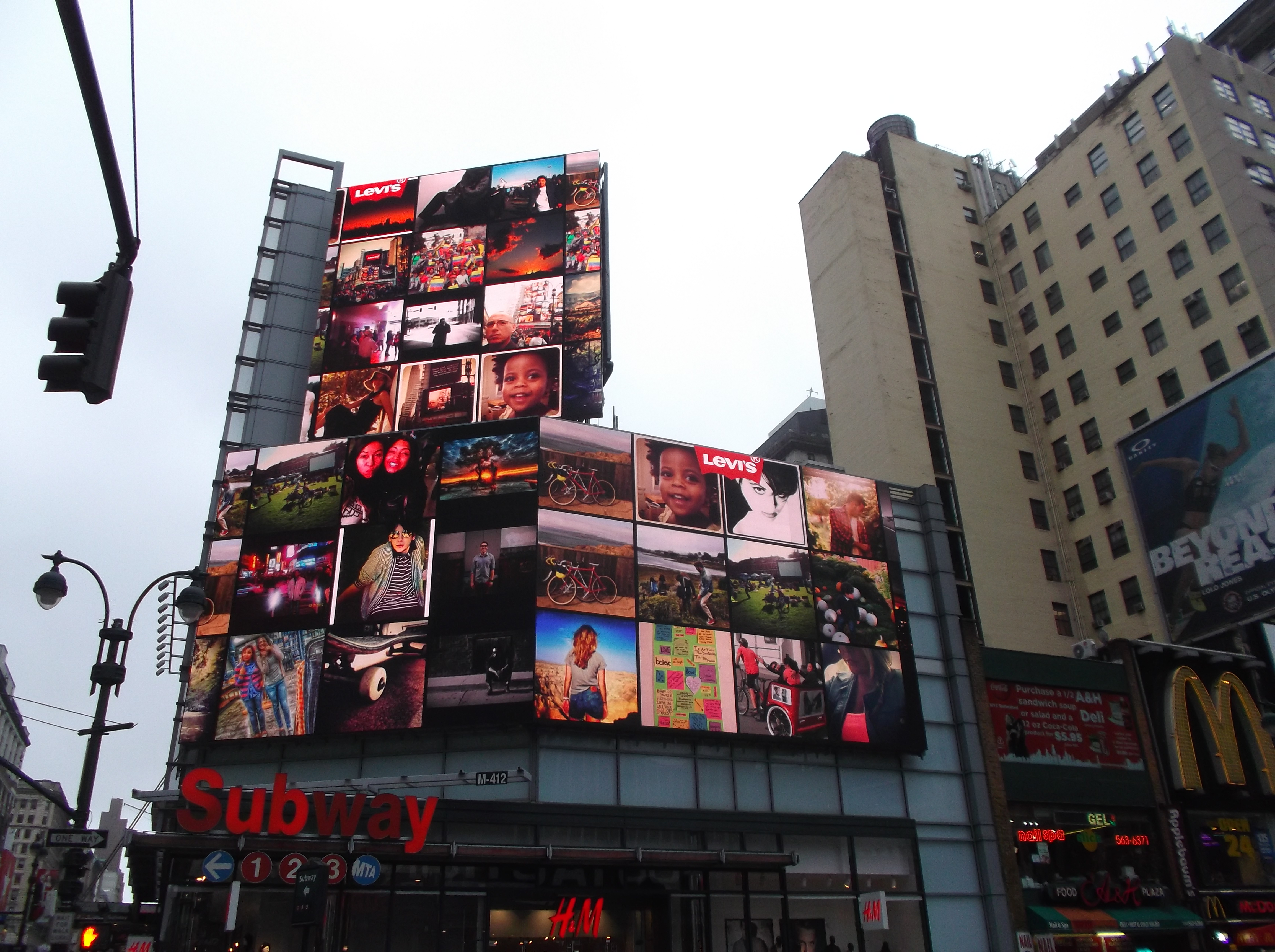
Following the crowd-sourcing theme, Levi's has managed to generate and broadcast consumer advocacy on a big scale by giving its audience a platform for expressing their own passions and creativity.
 
As part of the brands' Go Forth campaign, people could submit their Instagram photos using the #GoForth and #PostMe hashtags. The selected images appeared on a giant digital billboard overlooking Penn Station on 34th St in New York City. A brand TVC also ran on the billboard along with messages to join the campaign.
 
Effectively utilising social media channels, by understanding social media behaviours, along with the high impact digital billboard, ensured the campaign extended far beyond just those on 34th Street.
Levi's, who appear to keen to be a leader on the new media front, have also used Instagram to crowd-source talent for its marketing campaigns. They've previously asked men and women looking to be cast in a denim advertising feature to submit their photos using the #iamlevis hashtag.


Learnings: People love sharing their passions.

Imagine: WW is effectively at the heart of every great Aussie celebration – as food is the thing around which people come together. What if WW was the brand that celebrated these great Aussie occasions by mobilising Australians to share photos of their own great Aussie occasions that we can then publish and broadcast. eg. We could encourage people to share their best summer holiday BBQ shots and broadcast them across massive digital billboards in key locations, across social platforms, on the big screen at the cricket. Or thinking bigger, Australia Day images projected live on to the sails of the Opera House on Australia Day. Something fresh for the brand and a unique way to maintain our SOV presence in the lead up to Australia Day, and lay a strong platform for tactical and P&P activity to build upon.


eBay evolves the online shopping experience

 
Taking inspiration from Facebook, Twitter and Pinterest, eBay in the US has launched its new look site that it believes will deliver a much more rewarding online shopping experience. The key elements of the new site are a new visual design, that relies heavily on rich imagery, and a more personalised offering, including recommendations based on a member's preferences, interests and previous purchases.
New features include a personalised home page with personalised recommendations, a Facebook style ‘News Feed’ and the ability to follow products or brands. The curated personalised homepage takes design cues from Pinterest and trends we’re seeing in aggregation apps such as Flipboard, Rockmelt and now even Windows 8, with a ‘tiled’ layout the relies heavily on rich images.
 
 
There are also functional improvements with members able to get to key product details faster and complete a purchase in as little as two clicks. In addition users can link their Facebook page and sellers have the opportunity to embed YouTube video.
In a signal that there is a need to improve the online shopping experience, eBay's chief technical officer Mark Carges said a lot of online shopping "killed most of the pleasure of shopping" and that "we are reintroducing all those elements."
Mobile remains an important element for eBay with executives citing that people in the US spend more time on the site from mobile than desktop. In fact, 10,000 vehicles are sold each day on eBay mobile in the US. 

The new design is due to hit ebay.com.au in November, with additional features slated for roll out in the New Year.

Find out more here http://www.ebay.com/new
 

Learnings for us: Despite the nation’s apparent appetite for taking up new technology and trends – social, mobile, tablet just to name a few – our big brands have been slow to take the lead on the online shopping front. As a result the online shopping experience is far from enjoyable, particularly compared to the offline experienced.

There’s an opportunity to follow eBay and lead the way on delivering an enjoyable online shopping expereince - beyond simply making products available for purchase online. The two key elements are visually rich and personalised. We have the opportunity to move beyond the functional, list and thumbnail layout of most online shops, to a layout that is more intuitive and visually stimulating. We can personalise the site for individual users in terms of content, products and recommendations, based on a users’ preferences, interests and behaviours. The reward for this investment would see people place greater value on the site and brand, meaning they’ll place more value on it, use it more often and be more open to the recommendations provided.

Monday, 22 October 2012

Four tech trends - and what they mean for marketers

How will the rapid pace of technological change affect the work of brand owners and marketing agencies?

Here are four key trends that will play out across the next five years – each with implications for brand strategy and communications programmes.

1. Hyper-connected devices


Devices will connect and communicate at increasing speeds. Connected media devices are constantly emerging, and they represent a wider spread of apparatus than the mobile telephone and tablet computer: internet-enabled fridges, interactive billboards, televisions, surface computers, vending machines, personal media devices, cars and even buildings are already talking to us via mobile devices and the internet. In the not-too-distant future, they will be talking to each other as well, and talking fast. Hardware will be hyper-connected.

This area is developing fast. Seven major mobile operators from around the world recently agreed to work together to develop an international 'machine-to-machine' platform that would help devices talk to each other.

Implications for brand strategy

Creating useful device connections can help brands build 'love'. However, there are myriad ways to make the most of this insight. From a creative perspective, ideas like the Project Re:Brief 'Coke Vending Machine' is very interesting. It is a connected media reinterpretation of Coke's iconic 'Hilltop' spot, featuring the song 'I'd like to buy the world a Coke'. The mobile ad enables viewers actually to buy a Coke for someone in a city of their choice. As they watch the mobile ad, which ran on Google's Admob network, users could pick a city to send the Coke to, attach a text message and press a button that dispenses a drink at specially designed vending machines in that city. The viewer can even watch as their Coke is delivered to the recipient. But could ideas such as this also deliver ROI beyond brand equity? There may be business solutions, such as creating operational efficiencies or cutting cost leakages, that will emerge from future brand ideas for connected devices.

A recent example of this embryonic practice would be Red Tomato Pizza's (Cannes Lions Winning) VIP Fridge Magnet from Dubai.

In this case, a small pizzeria chain boosted sales by handing out a fridge magnet that acted as an 'emergency call' button. When pushed, it used Bluetooth to connect with the pusher's mobile phone and set up an order for their favourite pizza.

How can brands respond? Brands should think about which things connect together and why. Which things are already connected today? There will be opportunities to run campaigns through connected devices that do not belong to the brand, as well as from a brand's own packaging or in-store media property.

Take interactive tables in retail, for example. What story could we tell as a consumer places their mobile on the table and it connects in real time? What should happen next? The creative format would be made up of multiple elements: the table surface/computer screen, the connected device, the retail environment, and a few other sensors such as the mobile's camera or sound from the speaker. There is a lot to play with. What would an advertisement look like across these devices? If a brand is a service, could it have a new digital personality once it is connected?

2. Hyper-connected applications


Mobile and web applications, and the personal and public profile information within them, will also be hyper-connected. That means information like social profiles, real-time media habits and purchase preferences: Facebook, Zeebox and Red Lazer profiles, for example. Coupled with connected devices, these connected profiles will have a significant impact on the way we do everyday things like shopping, travelling and consuming media and entertainment.

The way that people consume media is also changing. Connected television viewing, dual screening with mobile, and m-commerce are examples. The socialisation of TV is already in full swing (see www.zeebox.com).

Imagine for a moment that in five years' time you are watching a Bond film on an internet TV. It is connected to various devices and personal and commercial profiles. These profiles act as our spam filters. They do not allow irrelevant or unwanted messages to reach us, but they are open to new messages from brands which are relevant for that given place or time. Bond movies are famous for their product placement, which is great if you are in the market for an Aston Martin DB7, but most people are not. In the future there will be more product placement in the film, but we might see less. Only when Bond uses a product or service that is hyper-relevant to our profile, will the mobile buzz with an opportunity to have it delivered.

Implications for brand strategy

At first glance it looks like the hyper-connection of profile information will create a world where our mobiles buzz all the time and hassle us to buy too many things. On closer inspection, however, we might see something a bit different. The meshing of profile data with connected devices and digital objects through trusted infrastructures (Google, for example) should act as a filter through which irrelevant material will be blocked. This raises some challenges for brands, in that the audience will be in control of their 'filter', and brands will need to prove they are relevant. In theory, it will be much harder to reach the audience. But the filter will allow full access for trusted brands with relevant messages. In a culture of hyper-connectivity there will be no room for spam but lots of room, even preference for, relevant and contextual brand engagements. Can marketing thus become a service rather than an irritating interruption?

There is, unfortunately, the possibility this could lead to negative consequences. An insight into how is provided in Filter Bubble by Eli Pariser. The argument is that technology that filters out what it sees as irrelevant material can mean individuals are sheltered from viewpoints that challenge their ideas or preferences, narrowing their outlook.

3. The Mobile Hub


In a world where hardware and software are hyper-connected, it follows that the mobile phone will evolve into a digital hub. We will see more mobile 'phones' connected to other devices as we move around – train ticket barriers, bus stops, parking meters, EPoS systems, televisions, magazines, points-of-sale, packaging, outdoor billboards, fridges, stereos, heating and lighting systems, and cars.

It's apparent that a mobile will act as a wallet or train ticket, but what about as a receptacle for connected media distribution? One example might be when we pick up a free movie on our mobile from a digital billboard. People will get used to 'picking things up' from locations, using their mobile device.

Implications for brand strategy

We should think about a future where our communications properties (including packaging and in-store media) become the origins for connected media engagements. Think of them as stations from which the brand can broadcast digital experiences. If a consumer connects their device to a press ad – or if they dual-screen with an advert on TV – what should a brand do next? What would the brand's connected personality do? If the consumer then goes in-store, should they be able to get out their digital hub and pick up something really special in the aisle, because of the previous interaction?

4. The Mobile-Directed Experience


The connected media audience will have more power and control than traditional media audiences. Within five years, we will see audiences that are used to manually controlling their experiences.

A recent example of this in action is the 360-degree gyroscope-driven brand experience created by XS2 for Dutch railway operator NS in The Netherlands. The mobile app allowed consumers to take a virtual tour around the Royal Waiting Rooms in the railway stations of Amsterdam and The Hague, using the phone to control their journey.

Further to this, audiences will be able to use the mobile device (as a digital hub) to direct the flow of media. They will be able to send media to other devices instantly. The mobile has already become the ultimate remote control. A top-of-the-range Mercedes-Benz comes with a mobile app to control the ignition, windows and all sorts of other functions.

The A-class, Mercedes' entry-level model, has Apple's Siri software integrated into its on-board controls for voice control via iPhone. In some cars it is already possible to pick up a video on a mobile phone and play it on the dashboard. In a future of connected media we might be able to pick up a video guide for making sushi from the fish counter at the supermarket, then take it home and 'fling' it to the screen in the kitchen with a swish of the hand. Another example might be picking up a free CD track from a petrol station then playing it in the car on the way home.

Implications for brand strategy

The emphasis will shift from 'push' to 'pull' media and communications. Brands will reap more rewards by organising their assets into a usable suite of digital units (apps, connected media programs, connected services, etc.), then inviting the audience to engage with them through traditional media and mobile. And when people do engage, brands should be ready to give them something entertaining or useful as a result, and allow them to take it away and use elsewhere.

Conclusion: A new creative landscape


Marketers are still in the business of human understanding – we use human understanding to create business advantage. But in the future this will mean understanding the way people adopt connected media technologies. Today we are in the mode of making insight-driven brand experiences; platform ideas that grow beyond a single media channel. In the future, advertising will need to change again. Advertising will evolve into giving ideas to the audience: ideas of real value, as advertisements. We will be creating connected media campaigns that contain ideas that they can use right away; campaigns that invite engagement from the audience and enable brands to give valuable ideas to customers, through connected media and devices.

A connected media landscape might equip advertising to become a service. It's a tall order, and there are significant issues of privacy to be ironed out. But with power going to the consumer, and the mobile mode being 'pull communications', brands could do worse than to plan how to be creative and tell stories across devices and locations.

In the first stages it might be about realising and responding to current facts about the audience. More people will be dual-screening on their mobile devices while watching TV – so ask what can your brand do to make the most of that. One response might be to take a look at your various mobile internet sites and how they present themselves via different types of search on mobile.

Another response would be to think about changing the creative content in the TV ads to take account for connected viewing, as Tesco in the UK has done.

Whether consumers are experiencing a brand through traditional media, through the packaging or the product itself, they have a connected media device in their hand. In the future there will many more connected things, and some of these things are already beginning to connect with each other. Now is the time to plan a digital personality for your brand and start to work out how it might be able to help people (or even the planet) when the world's connected media infrastructure is established.